House of Representatives Passes Bipartisan ALERT Act With Barrett’s Provisions To Improve Aviation Safety
H.R. 7613 Addresses Critical Issues That Contributed To Tragic Collision Over Reagan National Airport
Washington, D.C. — Today, the U.S. House of Representatives passed H.R. 7613, the Airspace Location and Enhanced Risk Transparency (ALERT) Act. This bipartisan aviation safety legislation, which passed with the support of Congressman Tom Barrett (MI-07), includes several key provisions Barrett led in response to the January 2025 mid-air collision between a Black Hawk military helicopter and a commercial aircraft in the skies above the Potomac, claiming 67 lives.
“Nothing Congress can say or do will ever bring back the 67 innocent lives lost in the tragic collision over Reagan National Airport in Washington, D.C. What we can do is make sure something like this never happens again,” said Barrett. “The ALERT Act we passed tonight with provisions I led takes significant steps towards making flying safer for every American by closing the military ADS-B loophole, advancing next-generation collision avoidance systems, and requiring regular equipment testing. These are provisions I fought hard for as someone with experience flying the exact type of helicopter involved in the accident, and I am confident they will save lives.”
Barrett, a member of the Transportation and Infrastructure Committee, worked with his colleagues on the committee, as well as the House Committee on Armed Services which shared jurisdiction over the ALERT Act.
“As a former Army helicopter pilot, Rep. Barrett’s insight and expertise were invaluable in assisting the Armed Services Committee in drafting the ALERT Act,” said Chairman Mike Rogers, House Armed Services Committee. “I applaud his work on this critical legislation to make our skies safer.”
“Congressman Barrett’s decades of experience as a U.S. Army helicopter pilot allowed him to provide invaluable insight as we developed the ALERT Act, and I greatly appreciate his efforts in helping to craft and pass this comprehensive safety legislation today,” said Chairman Sam Graves, House Transportation and Infrastructure Committee.
The ALERT Act includes key provisions from legislation Barrett introduced:
- Military ADS-B Out Loophole Act (H.R. 7240), which would prevent military helicopter pilots from turning off ADS-B Out transmissions during non-sensitive portions of flight missions;
- Next-Gen Collision Avoidance Assistance Act (H.R. 7239) to advance the deployment of the next generation of anti-crash technology in civilian and military aircraft;
- Safety in Shared Skies Act (H.R. 8072) to require the ADS-B Out system in military aircraft to be tested and serviced every 90 days.
Earlier today, Barrett spoke in support of the bill on the House floor and highlighted the urgency of addressing shortfalls in anti-collision and aircraft location systems in both military and commercial aircraft.
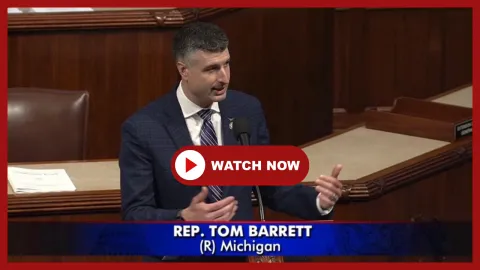
Click here or the image above to watch Rep. Barrett’s remarks.
Background:
The Traffic Alert and Collision Avoidance System (TCAS) is an interactive anti-crash technology used to direct pilots in two approaching aircraft to fly in specific directions and avoid a collision. The Automatic Dependent Surveillance Broadcast (ADS-B) system transmits an aircraft’s position data to other aircraft and air traffic control; ADS-B Out sends the signal, and ADS-B In receives the signal.
In addition to the provisions from Barrett’s three bills included in the ALERT Act, he also led the passage of the Military Helicopter Training Safety Act, which was signed into law in December 2025 and began the process of equipping military helicopters with TCAS, as well as ADS-B In.