Barrett Celebrates New Chip Testing Facility During Ribbon Cutting at Michigan State
New Research Facility Will Develop Radiation-Resistant Semiconductors for Military, Health Care, and More
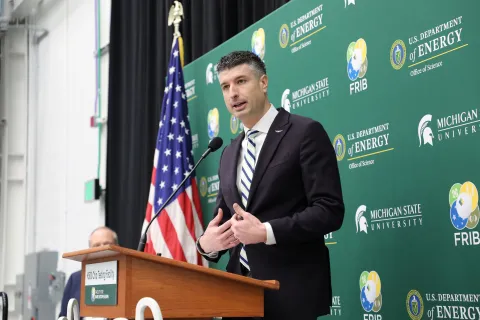
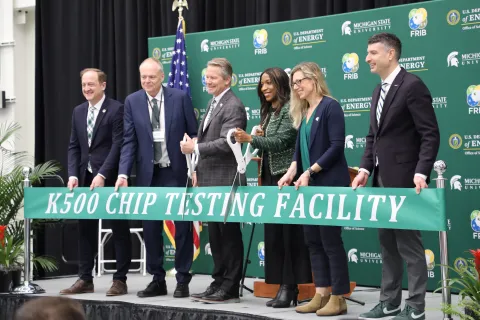
East Lansing, Mich. — Congressman Tom Barrett (MI-07) today joined Michigan State University leadership and faculty for a ribbon-cutting at the new K500 Chip Testing Facility, which will help address a critical shortage in testing capacity for radiation-resistant semiconductors needed for defense technology, medical equipment, and other advanced electronics.
The new facility, which was partially funded by $14 million in federal defense funding, is part of MSU’s Facility for Rare Isotope Beams (FRIB), where scientists perform nuclear physics research that is also critical for national security. Barrett secured an additional $125 million for FRIB’s research in a recent federal spending bill.
“MSU’s expanded K500 Chip Testing Facility will make mid-Michigan a hub for the next generation of durable semiconductor research, especially when it comes to military and medical technology,” said Barrett. “I’m confident that combining this new testing facility with the $125 million investment I recently secured for FRIB’s other nuclear physics research will help ensure scientists, staff, and students at MSU continue leading the way in cutting-edge innovation for years to come.”
“As a public, land-grant university, Michigan State University has a responsibility to steward public investment in ways that serve the nation,” said MSU President Kevin M. Guskiewicz, Ph.D. “For more than six decades, MSU has led the way in accelerator-based science, building world-class facilities and expertise that advance discovery, educate future leaders, and benefit society. FRIB continues that tradition, and with the inauguration of the K500 Chip Testing Facility, our scientists are turning cutting-edge research infrastructure into tangible value for Michigan and the nation. This facility is the latest chapter in a legacy of bold vision, technical excellence, and public service that defines MSU—transforming ambitious ideas into lasting impact.”
“Bringing the K500 Chip Testing Facility into operation required adapting a legacy accelerator to meet today’s mission and user demands,” said FRIB Laboratory Director Thomas Glasmacher. “The facility is now delivering beam to users and expanding national capacity for radiation effects testing at a time when demand significantly exceeds availability. This milestone reflects the strength of the FRIB team and our focus on operating complex facilities safely, reliably and in service to a broad user community.”
Background:
Cosmic heavy-ion rays from outer space can interfere with the performance of microchips, and manufacturers need durable semiconductors for autonomous vehicles, spacecraft and satellites, medical devices, wireless communications, and other electronics used in high-radiation environments. The K500 Chip Testing Facility, which simulates decades of cosmic-ray exposure in minutes, will welcome chip researchers from across the country, providing an additional 6,000 hours of testing capacity each year.
The federal investment for the K500 Chip Testing Facility builds on the federal government’s partnership with the Facility for Rare Isotope Beams, a user facility for the U.S. Department of Energy’s Office of Science. The advanced nuclear physics research conducted by MSU faculty, other scientists, and staff at FRIB has applications for national security, energy, medicine, industry, and more.
FRIB has contributed more than $1 billion to Michigan’s economy since 2011, with more than $100 million in the 7th Congressional District, which Barrett represents. It employs hundreds of workers from mid-Michigan and purchases from hundreds of local suppliers.
A government funding bill signed into law in January included $125 million Barrett secured for FRIB — $15 million to continue construction of its High Rigidity Spectrometer and $110 million for optimal operations and energy upgrades at the facility.
###