Preventing Another Tragic Crash
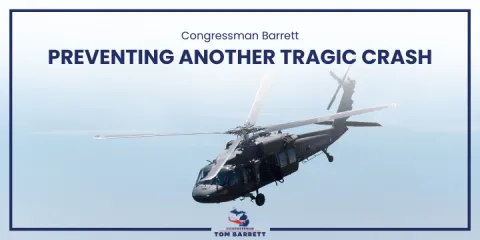
One year ago today, our nation was shaken by a devastating plane crash over the Potomac River between an American Airlines passenger jet and an Army Black Hawk helicopter. 67 lives were lost in the tragedy, which exposed glaring gaps in aviation safety. After years of piloting helicopters in the Army, I took the crash as a personal call to action.
Many factors contributed to the crash, and no single solution can solve all of them. But early on, I knew that if the Black Hawk involved in the crash had been equipped with the same anti-crash technology that commercial aircraft have, there was a chance we could have avoided this horrific tragedy. This technology, also known as a Traffic Alert and Collision Avoidance System (TCAS), interacts with the same systems in other aircraft, telling both pilots to fly in different directions to prevent a crash.
The night of the crash, I was in contact with some of the best pilots I know to get their insight and advice. Only weeks later, I introduced the Military Helicopter Training Safety Act (H.R. 1898). This bill kickstarts the process of equipping military helicopters with these systems. After months of advocating for this important legislation, I secured bipartisan approval of my bill, and President Donald Trump signed it into law as part of a larger defense package in December 2025. This legislation was a critical step towards making our skies safer, but there is more work to do.
That is why this week, I am introducing two additional bills to expand upon that work to prevent tragedies like the one that took place a year ago.
The Military ADS-B Out Loophole Act (H.R. 7240)
Despite the lack of TCAS, military helicopters are typically equipped with Automatic Dependent Surveillance-Broadcast Out (ADS-B Out), a system that transmits an aircraft’s location to air traffic control and nearby pilots. Current military protocol allows pilots to disable this technology when flying sensitive missions, but the exception is applied to all sorts of missions where secrecy isn’t necessary. The helicopter involved in the D.C. crash had ADS-B Out turned off, even when the flight reached crowded civilian airspace near the Reagan National Airport. My new bill will spell out clear standards for which missions are truly sensitive, closing loopholes and ensuring military flights use this critical safety technology.
The Next-Gen Collision Avoidance Assistance Act (H.R. 7239)
This bill would take steps to implement the next generation of collision-avoidance technology in military and civilian aircraft. This is the latest version of Airborne Collision Avoidance System (ACAS) technology, another name for TCAS. The newly developed ACAS-X system is designed to provide pilots with earlier and more precise alerts to prevent crashes. ACAS-X also has the potential to operate more effectively in low altitudes, such as the skies near airports where numerous planes are taking off and landing. ACAS-X gives pilots additional tools they need to prevent mid-air collisions and keep travelers safe, and my bill will direct the Federal Aviation Administration (FAA) to help airlines, manufacturers, and the military develop a plan to adopt this technology as soon as possible.
On this somber anniversary, I remain committed to increasing safety in the sky for pilots, crew, and passengers. Preventing another tragedy like the one over the Potomac requires accountability and innovation, and these bills are designed to deliver both.